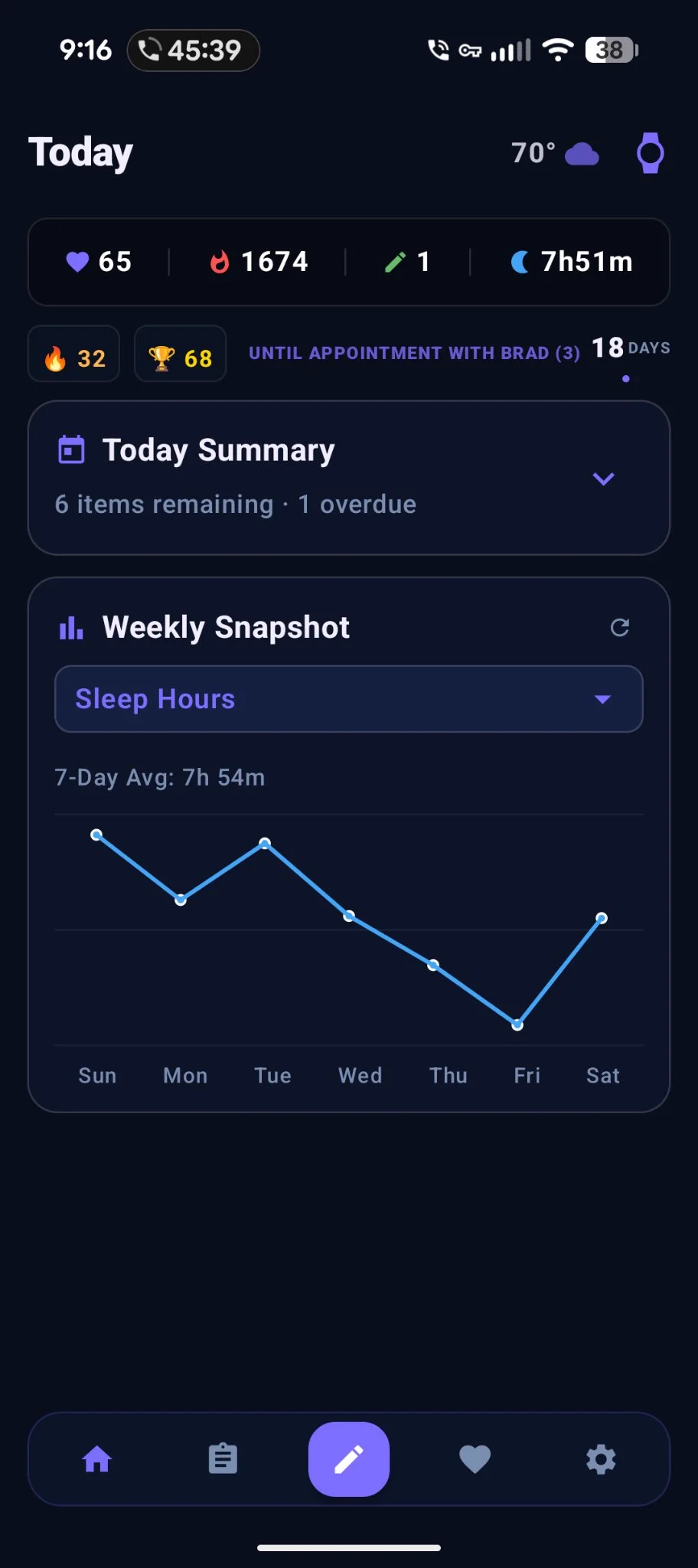
Now in private beta on Android — join the tester list.
AI pattern insights for your health log
The notes app that builds with you.
Log symptoms, routines, and biometrics in seconds. Tabs finds the patterns in your data and turns them into insights you can act on — plus clinical reports your doctor will actually read.
Walk in with a clinical audit report: an AI-written narrative — your summary, symptom and biometric correlations, long-term physiological trends, a medication and intervention analysis, and a clinical summary for your doctor — formatted for your medical team.
SAMPLE
Tabs — Clinical Audit Report
Report Range: Full Audit (180 Days) • Generated: Aug 9, 2026 - 08:29 PM
USER SUMMARY
Jordan Ellis is a 24-year-old male managing multiple chronic conditions, including a dysautonomia-related condition.
SYMPTOM & BIOMETRIC CORRELATIONS
Migraines appear every time his heart rate exceeds 155 bpm — a significant, recurring pattern in his self-reported symptoms.
LONG-TERM PHYSIOLOGICAL TRENDS
Average heart rate 68 bpm and HRV 58.4 ms over 180 days, with episodes exceeding 155 bpm on minimal exertion.
MEDICATION & INTERVENTION ANALYSIS
Pulsecalm initiated April 9, 2026; switch from Trenquix to Clarimood after chest pain.
CLINICAL SUMMARY FOR YOUR DOCTOR
Daily migraines, fatigue, and sleep disturbances remain the top concerns; five key questions for discussion.
Your daily logs turned into clean, professional reports your medical team will actually read.
Protocol Sync
Bring your doctor's instructions into the app. Tabs tracks your daily data against your prescribed protocols.
Voice Input
Tap the mic and talk. Transcribed exactly as you say it — no cleanup, no paraphrase.
Environmental Tracking
Weather context on your logs, so you can see how the environment lines up with how you feel.
Private by Design
Encrypted in transit, never sold, deleted when you say so. Your health data belongs to you.
01
say it, and it's logged
Log your way
Tap the mic and talk through your day — symptoms, meals, meds, whatever's on your mind. Tabs transcribes your words exactly as you say them, or log by tap when you'd rather type. Either way, it takes seconds.
Tabs connects your symptoms, biometrics, and environment to surface the patterns you'd miss on your own — like headaches clustering after short-sleep nights. Insights are generated by AI, and you review them before they go anywhere.
One clean PDF per visit: an AI-written narrative — user summary, symptom and biometric correlations, long-term physiological trends, a medication and intervention analysis, and a clinical summary for your doctor — plus data-availability counts and longitudinal health charts.
Sample report shown. Fictional patient, fictional data — watermarked SAMPLE.
SAMPLE
Tabs — Clinical Audit Report
Report Range: Full Audit (180 Days) • Generated: Aug 9, 2026 - 08:29 PM
USER SUMMARY
Jordan Ellis is a 24-year-old male managing multiple chronic conditions, including a dysautonomia-related condition, a connective-tissue condition, a mast-cell–related condition, and a spinal curvature condition.
His current prescribed medication regimen includes Pulsecalm, Clarimood, Thymavine, and Kepvion, all taken daily as prescribed. He also self-reports taking a B-complex vitamin, Vitamin D3 (20 mcg (4,000 IU)), and Nervexa (50mg, 1½ twice a day).
He actively manages his conditions through physical therapy for rib and back pain related to his connective-tissue condition and spinal curvature, consistent use of compression garments (calf, socks, shorts, chest band), and a daily intake goal of three-quarters of a gallon of water and 4,500 mg of electrolytes with supplemental salt.
Regular follow-ups with Dr. Elena Marsh are scheduled monthly to adjust his lifestyle and medication plan.
SYMPTOM & BIOMETRIC CORRELATIONS
Heart Rate and Migraines: The user consistently reports migraines, often daily, and notes a specific trigger where migraines appear every time his heart rate exceeds 155 bpm. This correlation is a significant and recurring pattern in his self-reported symptoms.
Fatigue and Activity Levels: Periods of increased physical, mental, or social demands frequently correlate with heightened fatigue and energy crashes. For example, in late July, days noted as “Mentally demanding,” “Socially demanding,” or “Physically active” were often followed by reports of “Fatigue” (e.g., July 27, 26, 24, 23, 21, 19, 18, 17, 14). The user specifically noted on May 20 that a “holiday weekend” involving physical exertion led to “the worst I’ve felt,” with subsequent reports of body aches, brain fog, and extreme tiredness.
Rib Pain and Physical Therapy: Rib and back pain, attributed to his connective-tissue condition and spinal curvature, are frequently logged symptoms. The user noted on February 8 that his “back hurts after physical therapy,” indicating that therapeutic interventions, while necessary, can acutely exacerbate musculoskeletal discomfort. Pain in the left rib, sometimes described as “hurts to breathe,” is a persistent issue, appearing on numerous dates across the reporting period (e.g., July 1, June 29, 27, 24, 23, 22, 21, 20, 19, June 1, May 26, 25, 21, 16, May 8, 2, 1, April 25, 19, 17, 16, 15, April 9, March 31, March 5, February 27, 23, 20, 14, February 11, 7, 3).
Symptoms Consistent with His Autonomic Condition: Symptoms consistent with his dysautonomia-related condition, such as “seeing stars when standing” (August 3, June 29, April 28), “dizziness” (April 23), “light-headed” upon standing (April 10), and “blood pooling in feet” (June 17, June 10, May 9, March 14), are regularly reported. These often coincide with reports of heart palpitations, particularly upon positional changes (e.g., “rolling over in bed” on June 3, June 1, May 30, April 14, 12, or “sitting up” on May 30, March 4).
Sleep Disturbances and Mental Health: Sleep quality and duration are highly variable. The user frequently reports waking up tired, experiencing insomnia, or waking up multiple times during the night (e.g., August 7, February 21, 20, 18, February 10, 9, 8, 7, 4, 3, 2). On August 7, a “hard mental night” with “very vivid dreams” led to waking up “depressed and upset,” highlighting a direct link between sleep quality and mood.
Allergy and Immune System Indicators: Recent allergy testing in July 2026 showed negative results for common food allergens, but positive IgE reactions to several environmental allergens, including Bermuda Grass (Class I), Timothy Grass (Class II), Maple/Box Elder (Class 0/1), Mountain Cedar (Class 0/1), and Russian Thistle (Class 0). These findings may be relevant to his mast-cell–related condition symptoms. Additionally, June 2026 lab results indicated a blunted response to several pneumococcal vaccine types, suggesting possible immune system vulnerabilities.
LONG-TERM PHYSIOLOGICAL TRENDS
Heart Rate and HRV Stability: Over the 180-day period, the average heart rate was 68 bpm, with an average HRV (RMSSD) of 58.4 ms. While the average heart rate appears stable, the user’s self-reported heart rate instability, with episodes exceeding 155 bpm and even 195 bpm on minimal exertion, indicates significant autonomic dysregulation consistent with his dysautonomia-related condition.
Sleep Patterns: The average sleep duration was 6h 52m per night, with an average deep sleep of 1h 08m. Despite these averages, frequent logs indicate disturbed sleep, including difficulty falling asleep, early awakenings, and waking up tired, suggesting that the quality of sleep may be more problematic than the total duration.
Heart Rate Spikes: A total of 214 heart rate spikes were recorded over the period. The user’s observation that migraines appear when his heart rate goes over 155 bpm is a critical insight for managing his dysautonomia-related condition and migraine conditions.
Energy Levels and Pacing: The user frequently reports low energy, fatigue, and mental exhaustion, often after physically or mentally demanding activities. The “Pacing Budget” consistently shows a value of 8, while “PacePoints” vary, sometimes exceeding the budget significantly (e.g., 19.4 on July 23, 16.2 on July 21, 17.1 on July 18, 15.3 on July 17, 16.8 on July 16, 18.1 on July 14, 16.4 on July 13, 22.7 on July 6). This suggests challenges in consistently adhering to pacing guidelines, potentially contributing to symptom exacerbation and crashes.
Weight and BMI: With a height of 178.2 cm and a weight of 148.5 lbs, the user’s BMI is 21.2 kg/m2, which is within the healthy weight range. This was noted in the March 2026 cardiac imaging report.
Blood Pressure Trends: The average blood pressure across five readings was 117/76 mmHg. A specific reading on February 28, 2026, was 118/75 mmHg, and another on July 28, 2026, was 121/84 mmHg. These readings generally fall within a healthy range, though the diastolic pressure on July 28 is at the higher end of normal.
MEDICATION & INTERVENTION ANALYSIS
Pulsecalm Initiation: The user started taking Pulsecalm on April 9, 2026, as noted in his logs. In late April, he reported that “the pulsecalm is helping a little but it makes me tired.” This suggests a partial benefit in symptom management but with a notable side effect. His profile lists Pulsecalm as an active medication, taken daily.
Antidepressant Transition (Trenquix to Clarimood): The user’s logs indicate a switch from Trenquix to Clarimood. On July 25, 2026, he reported taking Trenquix 40mg and experiencing “stomach pain.” By July 28, 2026, he noted “we switched from Trenquix to clarimood because of the chest pain from before,” and subsequently logged taking Clarimood 40mg daily. This transition was made to address adverse effects, specifically chest pain, associated with Trenquix. He continued to report “chest pain still and a lot of hunger” on July 26, possibly as residual effects or new side effects of the antidepressant.
Peptide Therapy: Thymavine and Kepvion are listed as active medications in his profile and are consistently logged as taken daily from June 22, 2026, through August 5, 2026. No specific symptom changes are directly attributed to their initiation in the provided logs, but their consistent use indicates ongoing therapeutic intent.
Nervexa, B-Complex, and Vitamin D3: The user self-reports taking Nervexa, a B-complex vitamin, and Vitamin D3 daily. Lab results from May and July 2025 indicated low Vitamin D levels (22.7 ng/mL and 24.4 ng/mL, respectively), supporting the rationale for supplementation. B12 levels were within range (612 pg/mL) in July 2025.
Cefalora for Migraines: The user started taking Cefalora 50mg a day for migraines on February 19, 2026. No immediate impact on migraine frequency or intensity was explicitly logged following this initiation within the provided data.
Electrolyte and Water Intake: The user’s consistent effort to consume three-quarters of a gallon of water and 4,500 mg of electrolytes daily, including salt pills and hydration mixes, is a key behavioral intervention for his dysautonomia-related condition. Logs frequently mention “leg blood pooling” and “strong heart palpitations,” indicating that despite these efforts, symptoms of hypovolemia and dysautonomia persist.
Physical Therapy for Connective-Tissue/Spinal Issues: The user is actively engaged in physical therapy for pain in his ribs and back due to his connective-tissue condition and spinal curvature. Logs confirm that therapy can cause acute pain (e.g., “physical therapy made my back hurt and made it hard to sleep” on January 25, 2026), but this is part of the ongoing management strategy.
CLINICAL SUMMARY FOR YOUR DOCTOR
Improvements: The transition from Trenquix to Clarimood was initiated due to adverse effects, specifically chest pain, indicating a proactive approach to medication tolerability. Consistent adherence to Pulsecalm, Thymavine, and Kepvion, as well as electrolyte and hydration protocols, is evident. Food allergy testing was negative, ruling out common dietary triggers for his mast-cell–related condition, though environmental allergens were identified.
Areas of Concern: Daily migraines, often triggered by heart rates exceeding 155 bpm, remain a significant challenge. Persistent fatigue, low energy, and mental exhaustion, frequently exacerbated by activity, continue to impact daily functioning. Rib and back pain related to his connective-tissue condition and spinal curvature are ongoing, with physical therapy sometimes causing acute discomfort. Symptoms of his dysautonomia-related condition, including heart palpitations, dizziness, and blood pooling, are still prevalent despite current management strategies. Sleep quality is consistently poor, with frequent awakenings and reports of waking up tired, which also impacts mental well-being. Reduced pneumococcal antibody response suggests a potential immune deficiency that may warrant further investigation or targeted intervention.
Key Questions for Discussion:
Given the persistent migraines and their correlation with heart rate spikes, what further adjustments to Pulsecalm or other migraine prophylaxis could be considered?
How can the current pacing strategy be optimized to mitigate post-exertional malaise and energy crashes, particularly on days with higher physical, mental, or social demands?
What additional interventions or diagnostic workup could address the ongoing rib and back pain, especially considering the connective-tissue and spinal diagnoses?
Are there further strategies to improve sleep quality and address the associated mental health impacts, beyond the recent antidepressant switch?
Considering the reduced pneumococcal antibody response, is further immune evaluation or vaccination recommended?
What is the clinical significance of the low plasma histamine levels, especially in the context of his mast-cell–related condition, and does this suggest a need for adjustment in management?
Calories Burnedmin 1,240 · avg 1,980 · max 3,950 kcal
HR Spikes (≥100 BPM)min 3 · avg 14 · max 29 per day
Recorded Patient Notesmin 0 · avg 2 · max 17 per day
Disclaimer: This report is generated by AI based on personal logs and should be reviewed by a medical professional.
Privacy
Your health data belongs to you.
Encrypted in transit
TLS encryption between your phone and our servers.
Never sold
We do not sell your health data, and we never use it for advertising.
Delete anytime
Delete your account in Settings and your data is purged.
No location tracking
Location is used only for weather context on your logs. We don't store your location history.
Your logs sync to our secure servers so they work across your devices. Summaries and insights are generated with the help of Google's Gemini API. Read the full story in our privacy policy
Pricing
Free trial, then monthly or yearly.
Tabs is subscription-based. Exact pricing is shown in the app before you pay — never a surprise.
Cancel anytime in the Play Store.
Tabs surfaces patterns and summaries — it does not diagnose, treat, or replace your doctor's judgment. Insights are generated by AI and reviewed by you before sharing.
FAQ
Questions, answered.
No. We do not sell your health data to third parties, and we never use it for advertising.
Your logs sync to our secure servers so they work across your devices. Summaries and insights are generated with the help of Google's Gemini API, which processes your data as our subprocessor.
No. Tabs surfaces patterns and summaries — it does not diagnose, treat, or replace your doctor's judgment. AI-generated insights are reviewed by you before you share them.
Tabs is subscription-based: a free trial, then monthly or yearly plans. Exact pricing is shown in the app before you pay, and you can cancel anytime in the Play Store.
Tabs is on Android and currently in private beta. iOS is not available yet.
Join the private beta
Start keeping tabs on your health.
Log for a week. Bring the report to your next appointment. See what your data has been trying to tell you.